Seth Godin says when assessing an audience or creating a culture, the main question is, "Who are we and what do people like us do?" All 9th grade classes at my school read Romeo and Juliet. Our 9th grade PBL students decided that as Problem Based Learners, they needed to go about their Shakespeare experience in a different way. Students decided they wanted to perform the play but in a different setting than what Shakespeare ever would have chosen. After much discussion, the groups decided they would do the play in pantomime format.
While it sounds like it may be easier, every student had to know not only what their lines were, but also how to interact with others based on facial expressions and body language. The miming of the play led to greater knowledge of the intracacies of the play than my standard English 9 classes normally do.
Tuesday, July 5, 2016

Sunday, July 3, 2016
Building a PBL Program Going Into Year 3
As we neared the close of the 2015-16 school year, for whatever reason, the Arete PBL program had 66 kids committed for next year and many of our 9th graders were beside themselves that there wouldn't be 4 sections of each core area. Many accepted the fate that we would have to cut two classes worth of students to fit the prospective class sizes. A few students took it upon themselves to make sure there would be enough students to continue the program as it was this year. They examined the 9th grade class list, identified students they had gone to school with for the last 10 years and then organized the list of possible students by friend group and specifically talked with each student about joining.
The position of the PBL students is that anyone who is not doing PBL is missing out on a great experience.. Our current students organized meetings with their classmates to inform them about the benefits of PBL and how it will change their lives.
Many people, whether they are students or not, have difficulty presenting to their peers, not to mention asking them tough questions about their goals in their academic career and what they hope to get out of school. As impressive as our students were in assembling the groups to meet with and composing their sales pitch, some of their target group members were equally as impressive asking great questions. Another interesting aspect of the whole arrangement is that they kids who asked the best questions were the ones who decided to join us.
Thanks to the hard work of a few students, the Arete PBL Academy at Neenah High School will have four sections of each core content area for next year!
The position of the PBL students is that anyone who is not doing PBL is missing out on a great experience.. Our current students organized meetings with their classmates to inform them about the benefits of PBL and how it will change their lives.
Many people, whether they are students or not, have difficulty presenting to their peers, not to mention asking them tough questions about their goals in their academic career and what they hope to get out of school. As impressive as our students were in assembling the groups to meet with and composing their sales pitch, some of their target group members were equally as impressive asking great questions. Another interesting aspect of the whole arrangement is that they kids who asked the best questions were the ones who decided to join us.
Thanks to the hard work of a few students, the Arete PBL Academy at Neenah High School will have four sections of each core content area for next year!
Wednesday, June 29, 2016
I'll Just Do it in Summer School
"I'll just do it in summer school," usually said with a shrug, those are words I have heard from high school students who are failing classes. For some of them, a few minutes of work is the only thing keeping them from having to go to summer school. After talking with the student, parents, special education teachers (if appropriate), and the guidance department to help the kid pass, but sometimes they still won't do the work necessary to pass.
Recently I may have figured it out. Growing up in a house with a mother who was there anytime we needed her and never having to worry about anything bad happening, I could not understand kids who would genuinely say they didn't want break to come. They not only dreaded the big breaks like Christmas, Spring Break and Summer, but also even having one day off. As a kid, from my perspective, those were the greatest days of the year.
They generally don't love school that much. A lot of them say they hate it, but the fact is that many kids need school for the routine, safety, security, meals and the good excuse not to be at home. It is great they have a place to go to feel safe and that they have had a positive enough experience in school to want to go for an extra month or two during the summer.
I am sure that there are more schools and students around the country who are playing his game. The question is, what can be done to give students the same qualities as school, but also makes them better than kids who don't go to summer school. Is it internships, sports, volunteering, a mentor, something else? Instead of those kids feeling like they want to do summer school for a completely non-academic reason, can districts use their community connections to create a program or programs with the goal to propel kids forward rather than giving them more of the same they got during the school year.
Maybe if they knew they had a positive experience awaiting them in the summer, they would choose to pass their classes and also gain important life experiences during the same times that summer school runs.
Recently I may have figured it out. Growing up in a house with a mother who was there anytime we needed her and never having to worry about anything bad happening, I could not understand kids who would genuinely say they didn't want break to come. They not only dreaded the big breaks like Christmas, Spring Break and Summer, but also even having one day off. As a kid, from my perspective, those were the greatest days of the year.
They generally don't love school that much. A lot of them say they hate it, but the fact is that many kids need school for the routine, safety, security, meals and the good excuse not to be at home. It is great they have a place to go to feel safe and that they have had a positive enough experience in school to want to go for an extra month or two during the summer.
I am sure that there are more schools and students around the country who are playing his game. The question is, what can be done to give students the same qualities as school, but also makes them better than kids who don't go to summer school. Is it internships, sports, volunteering, a mentor, something else? Instead of those kids feeling like they want to do summer school for a completely non-academic reason, can districts use their community connections to create a program or programs with the goal to propel kids forward rather than giving them more of the same they got during the school year.
Maybe if they knew they had a positive experience awaiting them in the summer, they would choose to pass their classes and also gain important life experiences during the same times that summer school runs.
Monday, June 27, 2016
Art, Books and Connections
The last few years I have been reading business, entrepreneur, psychology, leadership and education books almost exclusively. Daniel Pink, Seth Godin, Robert Cialdini, Sir Kenneth Robinson, Malcolm Gladwell are among the many different authors whose books I have explored.
With each book I read, I start by putting a 4 x 6 inch post it note inside the front cover to keep track of interesting words, concepts, people, websites and books as I read. I also take notes in the books and use colored coded post-its to mark the pages. For whatever reason, I use orange to mark ordinary notes. I feel they are the ones I want to be able to refer to later, but are not mind blowing. I use yellow for the mind blowing ideas. Pink are specific quotes I want to be able to use in the future and blue indicates connections between ideas.
Before I started to use different colors, I noticed that many authors refer to each other's books or at least to the same books during their discussion of ideas. In fact, it happened often enough for me to specifically mark those incidents.
One of the things I have long thought is, with all of the connections between books I have read, is there a theme that winds through all of them that ties them together?
Today as I was doing my Austin Kleon Steal Like an Artist Journal, I chose one which is an unlabeled web. with the instructions "Start in the Middle." For lack of a better term at the time, I chose "Art" as my central word. I am using the definition of art I derived from reading Steven Pressfield's book The War of Art. To me Pressfield is saying that art is beauty created through someone pursuing their passion.
After I chose my word, I started placing names of authors and books I have read in the last few years in the circles in the web. Unfortunately, the names I put in the list do not always come from the circle which precedes it. I think my best bet is to take my books and go into an empty room and examine the blue post its to attempt to determine which books inspired the others and how they fit together. Possibly then I will finally be able to create a singular idea that each book explored to some level.
Sunday, June 26, 2016
The Perfect Summer Activity: Steal Like an Artist
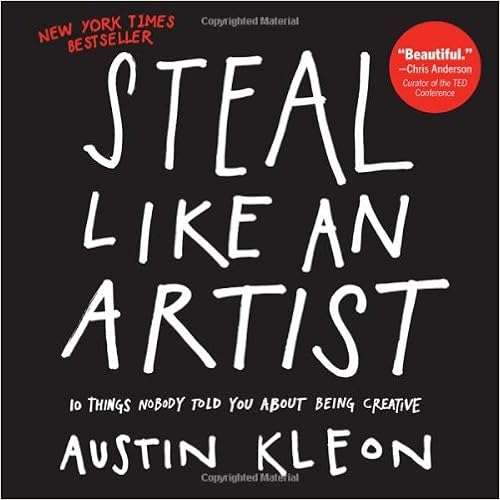 This summer in my house we are all working on creativity. After reading Austin Kleon's book Steal Like an Artist, I bought three copies of his Steal Like an Artist Journal for us to fill out. Each day we choose one entry to do then we may or may not share what we have written or drawn.
 The tasks Kleon includes in the journal ask the reader to take mundane objects and look at them in a new way. He encourages the reader to draw, listen, see, speak and feel using items or ideas such as: find an old receipt and try to recall as much as possible from that day. Ask someone to coffee and afterwards write everything that was discussed. Write your favorite quote and then say it in 5 different ways. I also love "Stare at this dot until you get an idea." One of my favorites is "Climb Up Your Own Creative Family Tree" where you identify who inspires you and then who influenced them, followed by who inspired the people who inspired the person who inspired you and so on. This exercise could take the entire summer, or an entire lifetime.
My first entry was from the page "10 Things I Want to Learn"
They are:
- Fishing
- 3D printing programs
- Steps showing how people learn
- juggling
- Guitar
- principles of drawing
- design process
- investing
- Spanish
- video editing
It is not all that often where adults encounter a list like this. In a way it may be a "bucket list" for me since many of these topics are those that even experts may continue to learn their whole lives. Maybe that means it is a good list. It would be interesting to fill out this list every few years and compare with previous lists to check on progress and/or changes.
As I peruse the book, especially at the entries I have already made, it seems that each entry has unstated steps which must be done to fully make it a creative endeavor, rather than something to do to check boxes to indicate completeness. One example is "10 Things Lying Around that No One is Using." The follow up is where the creativity comes into play. Should they be put together in a poem, picture, or story, taken somewhere and donated followed with a description of the next phase in their lives? When looked at in terms of being creative, there is no end to the book.
As I peruse the book, especially at the entries I have already made, it seems that each entry has unstated steps which must be done to fully make it a creative endeavor, rather than something to do to check boxes to indicate completeness. One example is "10 Things Lying Around that No One is Using." The follow up is where the creativity comes into play. Should they be put together in a poem, picture, or story, taken somewhere and donated followed with a description of the next phase in their lives? When looked at in terms of being creative, there is no end to the book.
Saturday, June 25, 2016
Think Big! Do Something Important! Change the World!
We started doing Genius Hour 7th hour on Thursdays in the first semester of the Arete PBL Academy. It was a learning experience for everyone. When one is passionate about something they will read, watch, ask questions and practice and in general find every means to learn about the topic.
Some kids knew what they wanted to do in the first thirty seconds. Others had a tough time finding a passion and joined with another person who was their friend, they thought would do all the work, or topic seemed interesting. Needless to say, those who pursued a passion enjoyed the time they were given and used it well. Those who weren't passionate about their topic usually were working in a group, generally with people they liked, but not necessarily with a topic they loved. That situation led to the one who was passionate about the topic feeling like the other person wasn't doing anything and the other person who wasn't really into it feeling like the passionate one was always bossing them around.
It took some of them awhile to figure out that each of them had skills they could leverage to push the project to success. For others, the main learning was that they didn't want to work on a project with a person who was not as passionate as they are, or that they didn't want to work on a project where they got to choose how to spend their time both in and outside of school, but didn't love.
At the beginning of the hour for each Genius Hour, we took the first three minutes and did a quick research tip, discussed a point where they should be in their project and waved the green flag by saying, "Think big, Do something important, Change the world." I used it was a touch point for everyone no matter which stage they were in with their project. Another frequent saying was Oliver Schinkten's expression, "If you didn't fail, then you fail." The expression fits into the Think Big portion of the project. By that I mean if you didn't think big enough for something not to work out, then you didn't think big enough.
Some kids knew what they wanted to do in the first thirty seconds. Others had a tough time finding a passion and joined with another person who was their friend, they thought would do all the work, or topic seemed interesting. Needless to say, those who pursued a passion enjoyed the time they were given and used it well. Those who weren't passionate about their topic usually were working in a group, generally with people they liked, but not necessarily with a topic they loved. That situation led to the one who was passionate about the topic feeling like the other person wasn't doing anything and the other person who wasn't really into it feeling like the passionate one was always bossing them around.
It took some of them awhile to figure out that each of them had skills they could leverage to push the project to success. For others, the main learning was that they didn't want to work on a project with a person who was not as passionate as they are, or that they didn't want to work on a project where they got to choose how to spend their time both in and outside of school, but didn't love.
At the beginning of the hour for each Genius Hour, we took the first three minutes and did a quick research tip, discussed a point where they should be in their project and waved the green flag by saying, "Think big, Do something important, Change the world." I used it was a touch point for everyone no matter which stage they were in with their project. Another frequent saying was Oliver Schinkten's expression, "If you didn't fail, then you fail." The expression fits into the Think Big portion of the project. By that I mean if you didn't think big enough for something not to work out, then you didn't think big enough.
Friday, June 17, 2016
Genius Hour--Getting the Go Ahead
In considering steps necessary to begin Genius Hour, I felt I had to let my administration know about the projects as well as the parents. I used these ideas below in my letter to parents and my discussion with administrators:
We are excited to inform you that we are introducing the Genius Hour (GH) project in English 9 classes this semester. We recognize that all students come to school with interests and talents which school typically may not acknowledge. This project is our way of applying those skills in a format which validates students' interests and is in tune with Angela Maiers’ saying, “You are a genius and the world needs your contribution.”
The idea and logic behind Genius Hour is very simple: allow people to work on something they are passionate about, and productivity will go up. Engineers at corporate giant 3M have worked in this way for over 60 years, famously producing Post-It Notes among other products. Google is the most celebrated company to incorporate 20% time into the work week. Google is not alone. Across the globe, increasingly, companies are using 20% time to increase employee satisfaction and production. Research based data confirms this policy works so well that 50% of Google’s projects have been created and implemented during this creative period. Ever heard of Gmail or Google News? These projects were creations by passionate developers during their 20% time projects. Our Genius Hour project is based on this Google philosophy.
Just like Google engineers, and countless students in schools across the country, our students will have one day a week in English class to devote to their passions. The benefits of Genius Hour within our curriculum are in line with Common Core State Standards and the findings of internationally renowned researcher and author Daniel Pink, who revealed that people worldwide are motivated by autonomy, mastery and purpose.
Here is how we will promote those qualities:
Autonomy--Allow students an opportunity to discover and investigate one of their passions
Mastery--Help to promote, support, and model creative, innovative thinking, communication skills and inventiveness to make our students experts in their area of passion
Purpose--Provide an avenue for students to reflect on and share their learning with others on how they will each make the world a better place and at the same time provide a forum for parents, community and school to partner and to support students’ learning.
Ultimately, the goal of Genius Hour will be realized when students improve their community through real world application of their research and share their knowledge in the form of a culminating project, with you (the parent), and the community, at our open house.
Subscribe to:
Posts (Atom)